Tuesday, November 6, 2012
OCTOBER 2012 Cycnoches Species & Hybrids published
The American Orchid Society has published with the October 2012 issue of Orchids a supplement on the genus Cycnoches. The supplement contains my article on the genus and its hybrids and Fred C. Clarke's article on Growing Cycnoches. The supplement was supplied at no extra charge to members of the American Orchid Society, however, non-members or persons who wish additional copies may purchase them at US$10.00 per copy plus postage and handling. Anyone interested should contact Naya D. Marcano naya@aos.org for details about postage costs. Payment is accepted by credit card.
Sunday, January 8, 2012
UPDATE FOR CLOWESIA JUMBO GRACE AND AGING

RICHARD FULFORD WHOSE EXPERIENCES I REPORTED LAST MONTH WITH HIS Cycnoches Richard Brandon, JUST EMAILED ME THAT HE HAD TRIED THIS TREATMENT ON HIS PLANT OF Clowesia Jumbo Grace (Cl Grace Dunn X Cl Rebecca Northen). Unlike the reaction of the Cycnoches, the Clowesia did not lose its fragrance and the flowers began to deteriorate. He took the plant out of the dark and moved it back outside in the 40-60 degree temperatures. He reports that the plant "perked up" and the flowers stopped deteriorating and remained fragrant. Unfortunately when he took it to judging it was passed with the comment that the flowers were past their prime. I can only speculate that perhaps the difference in reaction might be because Cycnoches bear male and female flowers whereas Clowesia are perfect flowers. I would very much like to know how female Cycnoches and Catasetum flowers would react to the darkroom treatment. If anyone has experience with this, please let me know.
Thanks to Richard for his observations and providing me with the information and the picture. Richard's plant illustrates one of the best features of Clowesia - the potential for amazing flowering on a small plant. Richard's plant has 130 flowers. You will note that it is completely leafless which is normal especially for the this hybrid and its parent species.
Tuesday, December 20, 2011
Cycnoches Richard Brandon 'Nicola' AM/AOS


December 11, Richard Fulford, a fellow Catasetinae fan and judge in the Florida/Caribbean Center, emailed that he had a beautiful plant of Cycnoches Richard Brandon in flower that he wanted to take to judging but the next judging in Florida/Caribbean was the following Saturday, December 17. He asked if I had any suggestions to prolong the flowers in good condition for the week until judging. I suggested that once the flowers were fully expanded, he should place them in a slightly cooler location with low or no light. He followed my suggestion. His observations of the flowers while in the dark are a fascinating study in the operation of the aging process of the flowers. Cycnoches Richard Brandon is a cross of Cycnoches warscewiczii X Cycnoches Jean E. Monnier (C. barthiorum X C. cooperi), made by Fred Clarke and registered by R.F. Orchids in May of this year.

The hybrid, like its component species, is extremely fragrant. Richard observed that after a short time in the dark, the fragrance disappeared. Fragrance indicates that the flower is mature and the pollen (in the male flowers) or the stigma (in the female flowers) is receptive for fertilization, a part of the aging process of the flowers. I think the disappearance of the fragrance means that the aging of the flowers was suspended during the period in the dark. When Richard brought the plant back into light, the fragrance returned. The flowers were granted an Award of Merit of 82 points at the December 17 judging at Florida Caribbean. I congratulate Richard on his well deserved award and on his observation of this process which I have never seen reported before. The pictures of Cycnoches Richard Brandon 'Nicola' that appear with this blog were taken by Richard.
Tuesday, July 26, 2011
Cattleya walkeriana books available for sale
If you wish to buy copies of Lou Menezes' new book Cattleya walkeriana all the information is on the page of Brazilian orchid literature on this site. If interested, email me at cycnoches@verizon.net or catasetinae@verizon.net. thank you
Monday, December 13, 2010
Introduction to the Catasetinae article
On Dec. 12, 2010, I posted a new page "Introduction to the Catasetinae" which is an article I was invited to write for the Scottish Orchid Society 2010 Bulletin. The article was published recently and I thought it might be of interest. It is an introductory article to the subtribe but I hope even the most advanced grower might find it of interest.
Saturday, February 13, 2010
MORMODES AWARD SUBMITTED FOR VERIFICATION
The fourth interesting Catasetinae flower picture that I received in January was a Mormodes awarded in the Cincinnati Judging Center as Mormodes speciosa. The plant belongs to Jordan Hawley from Kentucky and was granted an HCC pending verification of the species. Jordan emailed me the award picture and a copy of the award requesting my verification. From the picture, I thought that the flower did not appear to be M. speciosa so I requested a flower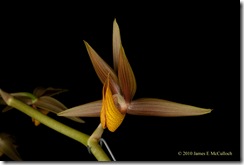

The flower looked very much like the Mormodes colossa that was identified in December as the first in this group but to be sure I requested that Jordan send me one of the flowers and additional pictures of the entire plant and side views of the flower. When identifying any flower the first question I ask is the origin of the plant, either the country or the vendor from whom it was purchased. Jordan had purchased the plant at the World Orchid Conference in January 2007 but didn’t remember the vendor or country of origin. The examination of the flower and the additional pictures confirmed my initial impression that this was a beautiful example of Mormodes colossa Reichenbach f. and not Mormodes speciosa Linden ex Lindley & Paxton. 
It is should be noted that the Kew Monocot checklist follows the original description which named the species Mormodes colossum but since of Drs Dressler and Salazar call the species Mormodes colossa I have chosen to use their version of the name although it does not match either the original description or the Kew Monocot checklist. I leave the question to the Latin scholars to decide which is correct.
Monday, February 1, 2010
AN INTERESTING VENEZUELAN MORMODES
The third of the pictures I received recently was from a Venezuelan friend Rafael Vaamonde. Rafael sent an email to a number of people interested in the Catasetinae asking about the identification of one of his Mormodes that had recently bloomed. Rafael said he had purchased the plant from indians in Ciudad Bolivar, the capital of the south-eastern Venezuelan state of Bolivar. The inflorecence measured 48 cm.


The first piece of information I always ask for when identifying a flower is “where does it come from”. In this case we knew that it came from the Venezuelan state of Bolivar. So I checked the list I have of Venezuelan Mormodes and these flowers seemed to match Mormodes carnevaliana Salazar & G. Romero, described rather recently in 1994. I sent an email requesting some additional information, but before anyone replied, I was forwarded a copy of an email from Dr. German Carnevali, the prominent Venezuela taxonomist which identified the flowers as Mormodes carnevaliana which had been named in his honor. Alexis Pardo had sent the pictures to Dr. Carnevali and he of course recognized the species named in his honor.
I checked the most recently issued AQ Plus 3.7 and this species has never been awarded in the AOS system. This attractive species probably is not in cultivation in the US although it obviously is in Venezuela. Thanks to Rafael for his permission to include his pictures.
Thursday, January 28, 2010
Catasetinae for identification Part 1 Catasetum
Starting just before Christmas, I have received pictures of an interesting assortment of flowers of the Catasetinae. The first on the list was the Mormodes colossa already discussed on my last blog of 2009 about Panamanian Mormodes. The next was a Catasetum from Mark Pendleton. Mark manages the boarding department of Brookside Orchids in California. He explained many plants show up in his department with no source data and this was one of those plants. This answered my first basic question when I receive a picture of an unidentified flower – the origin of the plant, including, if known, the country. The original pictures sent were female flowers. 

When identifying a Catasetum the first part of the flower I examine is the position of the antennae – the so-called “triggers” on the male column which, when touched, serve to expel the pollen onto the Euglossine bee that will deliver it to a female flower. Because the antennae are very sensitive, any touch will expel the pollen. The genus Catasetum is divided into two subgenera: Pseudocatasetum and Catasetum. Under the current rules of taxonomic nomenclature, if a genus is divided into parts, the part that contains the first species identified and on which the genus is based (the type species), always carries the generic name – in this case Catasetum. The type species of the genus is Catasetum macrocarpum and so the subgenus containing it is currently named Catasetum. The subgenus Pseudocatasetum contains only two to five species, depending on how the species are identified. The antennae of its male flowers are quite short, almost vestigial. The remainder of the some 160-180 species of the genus Catasetum are in the subgenus Catasetum.
The subgenus Catasetum is in turn divided into two sections based on the position of the antennae. Section Catasetum is based on the type species of genus, 

Now let’s look at the antennae of the flower sent by Mark. I have cropped the original picture to show a close-up of the lip, column and the antennae 
I hope that the information has been of interest and helpful to anyone trying to identify one of their plants. I will continue this series next with a Mormodes from Venezuela.
Tuesday, January 5, 2010
Happy New Year - and now for something completely different as Monty Python would say
Although my special interest is the Catasetinae, among other species that are favorites is Cattleya walkeriana. So I was particularly interested in an article published in the Boletin CAOB (=Coordenadoria das Associacoes Orquidofilas do Brasil) No. 71, July-September 2008, 38-43 titled Cattleya walkeriana trilabelo by Alcides Cavasini Filho. I had noticed at least two other Cattleya species on Brazilian sales lists that had been labeled as "trilabelo" before I saw this article. I had never seen pictures of them so I just assumed they were heavily peloric forms such as those of Cattleya intermedia aquinii. It was especially amazing to see this article and its pictures (taken by Sr. Cavasini) of a Cattleya walkeriana which indeed possessed three complete lips instead of the normal two petals and one lip.
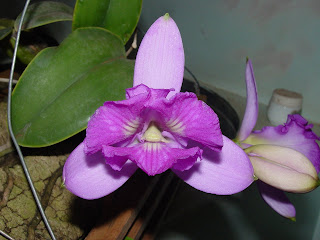 To the right is a picture taken of the 2009 blooming of the Cattleya walkeriana trilabelo 'Cavasini' showing the three completely formed lips and no petals.
Sr. Cavasini has given me permission to translate and publish his article in addition to the fine photographs which accompany it. I decided to publish a summary of the article and two of the pictures from him of this fascinating clone. Sr. Cavasini lives in Orlandia and his brother Andre Luis lives nearby in Guara, both in Sao Paulo state. The original plant was found near Catalao, Goias which is the Brazilian state at the heart of the Cattleya walkeriana habitat.
The article begins with a short history of the species, its discovery during a trip to Brazil 1817-1819 by Johann Emanuel Pohl and its rediscovery and subsequent publication in 1843 by George Gardner in the London Journal of Botany. The relationship to Cattleya bulbosa Lindley and Cattleya princeps Barbosa Rodrigues is explained with information on the habitat, plant, flowers and detailed instructions on the cultivation of Cattleya walkeriana. The history of the discovery of the trilabelo clone in 2002 by Sr. Figueroa Pires is related and the subsequent acquisition of the clone and its divisions in 2007 by Sr. Cavasini, his brother and brother-in-law Celio Dias Borges. They agreed to name the clone 'Cavasini'. The pictures which accompany the article were take on the second flowering of the clone in 2007. When I asked for permission for this blog, he sent me the picture above of the 2009 blooming. If anyone is interested in the complete translation, you may email me and I will send it to you with some additional pictures.
To the right is a picture from the article which shows one of the 2007 flowers forced open to show a better view of the three lips and the somewhat anomolous form of the column.
Cattleya walkeriana has a huge following and the ACW (Associacao Cattley walkeriana) and its affiliate in Japan, ACW Japan, hold shows for the species wth a special judging system developed by the ACW. We fans of the species are eagerly awaiting the publication of the new book by Lou C. Menezes, the Brazilian expert on the species. I understand the book should be published in mid-2010.

Sr. Cavasini has given me permission to translate and publish his article in addition to the fine photographs which accompany it. I decided to publish a summary of the article and two of the pictures from him of this fascinating clone. Sr. Cavasini lives in Orlandia and his brother Andre Luis lives nearby in Guara, both in Sao Paulo state. The original plant was found near Catalao, Goias which is the Brazilian state at the heart of the Cattleya walkeriana habitat.
The article begins with a short history of the species, its discovery during a trip to Brazil 1817-1819 by Johann Emanuel Pohl and its rediscovery and subsequent publication in 1843 by George Gardner in the London Journal of Botany. The relationship to Cattleya bulbosa Lindley and Cattleya princeps Barbosa Rodrigues is explained with information on the habitat, plant, flowers and detailed instructions on the cultivation of Cattleya walkeriana. The history of the discovery of the trilabelo clone in 2002 by Sr. Figueroa Pires is related and the subsequent acquisition of the clone and its divisions in 2007 by Sr. Cavasini, his brother and brother-in-law Celio Dias Borges. They agreed to name the clone 'Cavasini'. The pictures which accompany the article were take on
 the second flowering of the clone in 2007. When I asked for permission for this blog, he sent me the picture above of the 2009 blooming. If anyone is interested in the complete translation, you may email me and I will send it to you with some additional pictures.
To the right is a picture from the article which shows one of the 2007 flowers forced open to show a better view of the three lips and the somewhat anomolous form of the column.
Cattleya walkeriana has a huge following and the ACW (Associacao Cattley walkeriana) and its affiliate in Japan, ACW Japan, hold shows for the species wth a special judging system developed by the ACW. We fans of the species are eagerly awaiting the publication of the new book by Lou C. Menezes, the Brazilian expert on the species. I understand the book should be published in mid-2010.
Wednesday, December 23, 2009
A QUARTET OF PANAMANIAN MORMODES

THIS MONTH I WAS WORKING ON IDENTIFICATION OF A MORMODES AND IT INSPIRED ME TO ADD A PAGE TO THE BLOG ABOUT MORMODES. OVER THE PAST TWO YEARS, I HAVE RECEIVED SOME EXCELLENT PICTURES OF PANAMANIAN MORMODES FROM THREE PEOPLE. WITH THEIR PERMISSION AS NOTED ON THE PICTURES, I AM POSTING THEM FOR FELLOW LOVERS OF THE CATASETINAE.
 DR. ROBERT DRESSLER IN HIS FIELD GUIDE TO THE ORCHIDS OF COSTA RICA AND PANAMA DISCUSSES THE CATASETINAE IN A CHAPTER TITLED "THE BIZARRE SUBTRIBES". I LIKE THAT DESCRIPTION BUT IF THE CATASETINAE ARE BIZARRE, THEN I THINK MORMODES IS PROBABLY THE MOST BIZARRE OF ALL WITH ITS ASYMETRICAL TWISTED COLUMN AND LIP. AFTER ALL, THE NAME MORMODES IS FROM THE GREEK MEANING RESEMBLING A FRIGHTFUL OBJECT, A HOBGOBLIN.
 DR. ROBERT DRESSLER IN HIS FIELD GUIDE TO THE ORCHIDS OF COSTA RICA AND PANAMA DISCUSSES THE CATASETINAE IN A CHAPTER TITLED "THE BIZARRE SUBTRIBES". I LIKE THAT DESCRIPTION BUT IF THE CATASETINAE ARE BIZARRE, THEN I THINK MORMODES IS PROBABLY THE MOST BIZARRE OF ALL WITH ITS ASYMETRICAL TWISTED COLUMN AND LIP. AFTER ALL, THE NAME MORMODES IS FROM THE GREEK MEANING RESEMBLING A FRIGHTFUL OBJECT, A HOBGOBLIN.
 ACCORDING TO DR. GERARDO SALAZAR, THE ONLY EXPERT ON THE GENUS, THERE ARE SOME 80 SPECIES RANGING FROM MEXICO TO BOLIVIA AND BRAZIL. PANAMA HAS ADDITIONAL MORMODES SPECIES BUT I CHOOSE TO ONLY DEAL WITH FOUR OF THEM AT THIS TIME.


Mormodes hookeri 'Brent Baker' HCC/AOS owned by Brent Baker
Mormodes fractiflexa 'Ed Harris' CHM/AOS owned by Ed Harris
Mormodes fractiflexa 'Ed Harris' CHM/AOS owned by Ed Harris
Mormodes punctata owned by Ed Harris
Mormodes colossa Eric Hunt http://www.orchidphotos.org
Mormodes colossa Eric Hunt http://www.orchidphotos.org
Sunday, December 20, 2009
TWO NEW GENERA PROPOSED AS ADDITIONS TO THE SUBTRIBE
WELCOME TO THE SUBTRIBE TWO NEW GENERA AS PROPOSED BY THE AUTHORS OF THE RECENTLY PUBLISHED GENERA ORCHIDACEAUM VOLUME 5. THE PROPOSED NEW ADDITIONS TO THE ESTABLISHED FIVE MEMBERS OF THE SUBTRIBE, CATASETUM, CLOWESIA, CYCNOCHES, DRESSLERIA & MORMODES ARE GALEANDRA AND GROBYA. THE AUTHORS ADMIT THAT THIS MAY SEEM QUESTIONABLE BUT THEY SAY THEIR MOST RECENT MOLECULAR EVIDENCE SHOWS THAT THESE TWO GENERA ARE SISTER TO THE ESTABLISHED GROUP. SO WHO ARE THE NEW ADDITIONS? WE SHALL SEE HOW THIS ADDITION IS ACCEPTED.


Galeandra is a popular and widely-grown genus of some 40 species ranging from Florida to southern Brazil. The largest group are from Brazil. Two new species recently have been described from Brazil and they are available from my friend Vitorino Castro. To represent the genus this is a picture of Galeandra devoniana.
The other genus, Grobya, in contrast is a small genus of five species endemic to the Brazilian Atlantic Rainforest and is not widely cultivated outside Brazil. To represent the genus, above to the right, is a picture of Grobya amherstiae which is also available on the lists of my friend Vitorino Castro.
PREVIOUSLY, TAXONOMISTS HAVE PLACED BOTH GENERA, ALONG WITH CYRTOPODIUM IN OR NEAR THE CATASETINAE SO THIS IS NOT A COMPLETE SURPRISE AS HAVE BEEN SOME OF THE OTHER CHANGES FROM KEW. Over the next few years we shall see if this change is accepted in the orchid community but it is certainly worth notice.
Thursday, November 12, 2009
AOS AWARD PICTURES 20000120 AND 20041849
THE AWARD PICTURES FOR 20000120 AND 20041849 ARE USED WITH PERMISSION FROM THE AOS AWARDS PROGRAM FOR EDUCATION PURPOSES ONLY AND ARE COPYRIGHTS OF THE PHOTOGRAPHERS JOHANNA T. WILLINK FOR 20000120 AND RHONDA PETERS FOR 20041849. CORRECTIONS TO THE AWARDS TO Catasetum rectangulare G.F.Carr HAVE BEEN PROPOSED.


Tuesday, November 10, 2009
Name correction to AOS awards made as Ctsm callosum var. album


I believe that award 20041849, granted a CHM under the name Catasetum callosum var. album ‘MAJ’, is not Catasetum callosum but actually Catasetum rectangulare a new species which I described and published in 2005 when I was asked to verify provisional award 20051591 that had been granted in Miami as an album form of Catasetum poriferum Lindley. The description of the proposed new species and a brief account of my investigations were published in the Orchid Review vol. 114, no. 1267: 32-33, January-February 2006. In addition to comparing the flower to C. poriferum, Catasetum callosum Lindley was examined as a possibility. When I inquired about the flower with some Colombian friends, they said that in Colombia it was known as C. callosum var. album. A picture of a colored form of this species was published in Native Colombian Orchids Vol. 1: 59D – plant no. 48, 1994. In the same series Vol. 5, page 674D, plant no. 750 is the album form of the species as pictured in awards 20041849 and 20051591. A picture of the colored form is also found in The Orchid Picture Book 1995, page 8 identified as Catasetum callosum ‘Pecoso’.
Since the Colombians call these plants Catasetum callosum, horticulturally, we need to examine this species’ original description, drawings and published information.
Catasetum callosum was described by Lindley in 1840 in Edwards's Botanical Register 26(Misc.): 77
183. CATASETUM callosum ; petalis concoloribus lineari-lanceolatis sepalodorsali conformi suppositis, labello ovato-oblongo obtuso basin versussaccato supra saccum calo magno (aurantiaco) instructo margine obso-lete crenato, columnae acuminatae cirrhis vix ultra callum extensis.In habit this plant is exactly like Catasetum tridentatum,var. floribundum, but its flowers are quite different. Thesepals and petals are of a dull reddish brown, without spotsthe column is of the same colour, which may perhaps be bestcompared to that of old spoiled port wine. The lip is green,flat with a yellow tubercle near the base above the hollow,and a stain of the same colour near the apex. It was im-ported by Messrs. Loddiges from La Guayra, (no. 558).
In 1841, the following year, the description was republished with a drawing of the lip in Edwards’s Botanical Register vol. 27, t5
LOWER DRAWING ABOVE AT BEGINNING OF POST
1. Ctsm. callosum -The tumour-lipped Catasetum
2. C. cornutum -Horned Catasetum
3. C. barbatum var. proboscidium -Long-beaked Catasetum
4. C. laminatum var. eburneum -White-lipped Knife-blade Catasetum
5. C. lanciferum -Lance-bearing Catasetum
The tubercle for which the species is named is prominent and the obovate-triangular lip is notable in fig. 1.
Two more drawings are at the top above of the plant and partial inflorescences of Ctsm callosum which were published in Curtis’s Botanical Magazine, t4219 and t6648 from volume 108, September 1, 1882.
Since the Colombians call these plants Catasetum callosum, horticulturally, we need to examine this species’ original description, drawings and published information.
Catasetum callosum was described by Lindley in 1840 in Edwards's Botanical Register 26(Misc.): 77
183. CATASETUM callosum ; petalis concoloribus lineari-lanceolatis sepalodorsali conformi suppositis, labello ovato-oblongo obtuso basin versussaccato supra saccum calo magno (aurantiaco) instructo margine obso-lete crenato, columnae acuminatae cirrhis vix ultra callum extensis.In habit this plant is exactly like Catasetum tridentatum,var. floribundum, but its flowers are quite different. Thesepals and petals are of a dull reddish brown, without spotsthe column is of the same colour, which may perhaps be bestcompared to that of old spoiled port wine. The lip is green,flat with a yellow tubercle near the base above the hollow,and a stain of the same colour near the apex. It was im-ported by Messrs. Loddiges from La Guayra, (no. 558).
In 1841, the following year, the description was republished with a drawing of the lip in Edwards’s Botanical Register vol. 27, t5
LOWER DRAWING ABOVE AT BEGINNING OF POST
1. Ctsm. callosum -The tumour-lipped Catasetum
2. C. cornutum -Horned Catasetum
3. C. barbatum var. proboscidium -Long-beaked Catasetum
4. C. laminatum var. eburneum -White-lipped Knife-blade Catasetum
5. C. lanciferum -Lance-bearing Catasetum
The tubercle for which the species is named is prominent and the obovate-triangular lip is notable in fig. 1.
Two more drawings are at the top above of the plant and partial inflorescences of Ctsm callosum which were published in Curtis’s Botanical Magazine, t4219 and t6648 from volume 108, September 1, 1882.
The text of t6648 follows:
CATASETUM Callosum. Native of Venezuela.
Nat. Ord. Orchideæ.—Tribe Vandeæ. Genus CATASETUM, Swartz; (Benth. et Hook.f. Gen, PI. vol. iii. p. 551, ined.)
Catasetum callosum; pseudobulbis oblongis vaginatis, foliis obovato-oblanceolatis acutis plicatis, racemis multifloris, scapo rachi ovariisque rufo-brunneis, perianthii foliolis elongato-lanceolatis concavis acuminatis brunneis, sepalo dorsali petalisque erectis parallelis contiguis, sepalis lateralibus deflexis parallelis v. paullo divaricatis, labello hastato-ovato-v.-lanceolato luride virescente purpureo maculate obtuso convexo basi dorso saccato, apicem versus subtrilobo, lobo intermedio producto recurvo, marginibus crenulatis, callo basi virescente v. flavido, colnmna aurantiaca in rostrum elongatum gracile erectum producta.
C. callosum, Lindl. in Bot. Reg. 1840; Misc. n. 183 and 1841, t. 5,f. 1; Rchb.f. in Walp. Ann. vol. v. p. 568.
A form of the Catasetum callosum has been figured in this work (Plate 4219) under the name of var. grandiflorum; it, however, differs from the original plant described by Lindley, and now pourtrayed here, more in colour and narrowness of leaf than in the size of the flower; for whereas in this the sepals and petals are of a rich brown, and the lip a uniform dull green speckled with red, in the var. grandiflorum the sepals and petals are pale dirty-yellow green, with red-brown tips, and the lip is of a bright verdigris green with purple edges and spots, a bright-red tip and red callus. There can, however, be no doubt as to the specific identity of these two plants. It would be more interesting to know whether this species presents the different sexual forms that some other species of the genus do, and upon which the genera Monachanthus and Myanthus were founded by Lindley, the former representing a female form, having a short column without the cirrhi, a perfect stigma, and imperfect pollinia, and the latter a hermaphrodite form, with a ciliate lip and perfect stigma and pollen. In the plant here figured I found the anther and stigma well developed, but the cirrhi were not sensitive, and the pollen masses were very small and apparently imperfect, whence I assume that this was a hermaphrodite form, with a functionally imperfect fertilizing apparatus.
C. callosum is a native of La-Guayra and Venezuela, from which latter country the specimen here figured was procured. It was presented to the Royal Gardens by Mr. Sander, of St. Albans, and flowered in the Orchid-house in December of last year. Other varieties are described as C. Lansburgii Lindl. (Lindl. and Paxt. Fl. Gard.vol. i.p. 156), and var. crenatum, Regel (Gartenfl. vol. v. p. 275).
Descr. Pseudobulbs two to three inches long, clothed with sheathes. Leaves six to ten inches long by two to three broad, narrowly obovate or oblanceolate, plaited and strongly nerved. Scape radical, short; raceme pendulous, many-flowered; rachis very stout, red-brown; bracts half an inch, oblong-lanceolate, membranous. Ovary one to one and a half inches, slender, curved, red-brown. Perianth three and a half inches long, segments all narrowly lanceolate, acuminate, concave, bright-brown. Dorsal sepal and two petals quite erect, parallel and contiguous; two lateral sepals deflexed, parallel or slightly diverging. Lip one inch long, cordate- or hastate-lanceolate, convex, dirty green, speckled with red, with a short gibbous sac at the base behind, margins slightly toothed; tip three-lobed, mid-lobe elongate and recurved; callus yellow or green. Column dirty yellow, as long as the lip, ending in a long, slender, erect beak.—J. D. II.
---------------------------------------------------------------------------------------------------------------------------------
The early drawings illustrate the variability in the lip of the species, but they also illustrate the common features that identify them all as Catasetum callosum Lindley – the large tubercle and the obovate-triangular lip in contrast to the rectangular lip of Ctsm. rectangulare which is found only in Colombia. No album form of true Ctsm. callosum has been published to my knowledge.
A final point emphasizes the identification of this award as correctly Ctsm rectangulare and not Ctsm callosum and is on page 80 of Venezuelan Orchids Illustrated, vol 2, Catasetum callosum “Fairly common in many parts of the Coastal Range of Venezuela, this orchid is notable for the great variety of forms of its lip. So variable is this element, in fact, that it is rare to find two plants whose flowers have lips similar in all details. The unusual nature of this dissimilarity gains emphasis when it is remembered that the shape of the lip is in most orchids a very constant factor and therefore a major guide to the identification of the species.” Reviewing the pictures of Ctsm rectangulare in both color forms, the lip is consistently rectangular in shape as cited in the original description and not variable among different clones.
Plants of what is now Catasetum rectangulare have been in US cultivation since at least 1999. I had two plants of this species at that time. They were sold under the name Catasetum callosum var. album and I have a number of slides of my plants from 1999. They came from Colombia. I was suspicious at the time that they were not C. callosum and I pickled several flowers and inflorescences which I still have in my personal herbarium. Because several years had passed when I received award 20051591 to identify, I did not remember the earlier plants.
BIBLIOGRAPHY
Catasetum callosum Lindley
DUNSTERVILLE, G.C.K. & GARAY, L.A. Venezuelan Orchids Illustrated Vol. 2: 56, 57 drawings, 80 color plate, Catasetum callosum Lindl. 1962
The drawings found on page 57 are reproduced in Orchids of Venezuela An Illustrated Field Guide first edition page 80 and second edition page 75
ESCOBAR, R. editor Native Colombian Orchids vol. 5: 674, photographs B & C plants no. 748 & 749. 1994
LASSER, T. editor Flora de Venezuela - FOLDATS, E. ORCHIDACEAE Vol. XV, 4th part: 63-65 Catasetum callosum Lindl. 1970
BERRY, P.E., K. YATSKIEVYCH & B.K. HOLST. Flora of the Venezuelan Guayana Vol 7 – ROMERO-GONZALEZ, G.A. ORCHIDACEAE PART 20 CATASETUM: 263, 268 Catasetum callosum Lindl.
AOS AWARDS CORRECTLY IDENTIFIED IN THE AUTHOR’S OPINION AS Ctsm callosum:
19901074 Ctsm callosum ‘Katiusca’ CHM/AOS
19941175 Ctsm callosum ‘Debbie’s First’ CHM/AOS
19951710 Ctsm callosum ‘Milton Soloff’ CHM/AOS
20031851 Ctsm callosum ‘Stephen’s Pride’ HCC/AOS
20041255 Ctsm callosum ‘Sunset Valley Orchids; AM/AOS
Catasetum rectangulare G.F. Carr
Carr, G.F. The Orchid Review, vol. 114, no. 1267, January-February 2006: 33,34. Catasetum rectangulare A new species from Colombia.
Published as Catasetum callosum
ESCOBAR, R. editor Native Colombian Orchids Vol. 1: 59D – plant no. 48, 1994. In the same series Vol. 5, page 674D, plant no. 750
McDOWELL, D. The Orchid Picture Book: Catasetum callosum ‘Pecoso’ 1995: 8. - actually the colored form of C. rectangulare
SECOND AWARD
Award 20000120 granted a JC under the name of Catasetum callosum var. album is all female flowers. Because of the similarity of the female flowers among the species of Catasetum the establishment of the correct species is made only from the male flowers. As established, in my opinion, in my challenge to award 20041849, there is no true album form of Ctsm. callosum Lindley known and the plants that have been sold under this name are in fact Ctsm. rectangulare G.F.Carr. I would like to know if the male flowers of this clone were examined for verification of the species. If the male flowers were Ctsm rectangulare, then this award should be changed to Ctsm rectangulare. If the male flowers are some other species, I don’t know why it would have been called Ctsm. callosum var. album since according to Dunsterville & Garay, the female flowers of the species are green as are those of most Catasetum. If no verification of the male flowers is available, I think the name should be changed to Ctsm. rectangulare.
Bibliography
DUNSTERVILLE, G.C.K. & GARAY, L.A. Venezuelan Orchids Illustrated Vol. 2: 56, 57 drawings, 80 color plate, Catasetum callosum Lindl. 1962
Carr, G.F. The Orchid Review, vol. 114, no. 1267, January-February 2006: 33,34. Catasetum rectangulare A new species from Colombia.
CATASETUM Callosum. Native of Venezuela.
Nat. Ord. Orchideæ.—Tribe Vandeæ. Genus CATASETUM, Swartz; (Benth. et Hook.f. Gen, PI. vol. iii. p. 551, ined.)
Catasetum callosum; pseudobulbis oblongis vaginatis, foliis obovato-oblanceolatis acutis plicatis, racemis multifloris, scapo rachi ovariisque rufo-brunneis, perianthii foliolis elongato-lanceolatis concavis acuminatis brunneis, sepalo dorsali petalisque erectis parallelis contiguis, sepalis lateralibus deflexis parallelis v. paullo divaricatis, labello hastato-ovato-v.-lanceolato luride virescente purpureo maculate obtuso convexo basi dorso saccato, apicem versus subtrilobo, lobo intermedio producto recurvo, marginibus crenulatis, callo basi virescente v. flavido, colnmna aurantiaca in rostrum elongatum gracile erectum producta.
C. callosum, Lindl. in Bot. Reg. 1840; Misc. n. 183 and 1841, t. 5,f. 1; Rchb.f. in Walp. Ann. vol. v. p. 568.
A form of the Catasetum callosum has been figured in this work (Plate 4219) under the name of var. grandiflorum; it, however, differs from the original plant described by Lindley, and now pourtrayed here, more in colour and narrowness of leaf than in the size of the flower; for whereas in this the sepals and petals are of a rich brown, and the lip a uniform dull green speckled with red, in the var. grandiflorum the sepals and petals are pale dirty-yellow green, with red-brown tips, and the lip is of a bright verdigris green with purple edges and spots, a bright-red tip and red callus. There can, however, be no doubt as to the specific identity of these two plants. It would be more interesting to know whether this species presents the different sexual forms that some other species of the genus do, and upon which the genera Monachanthus and Myanthus were founded by Lindley, the former representing a female form, having a short column without the cirrhi, a perfect stigma, and imperfect pollinia, and the latter a hermaphrodite form, with a ciliate lip and perfect stigma and pollen. In the plant here figured I found the anther and stigma well developed, but the cirrhi were not sensitive, and the pollen masses were very small and apparently imperfect, whence I assume that this was a hermaphrodite form, with a functionally imperfect fertilizing apparatus.
C. callosum is a native of La-Guayra and Venezuela, from which latter country the specimen here figured was procured. It was presented to the Royal Gardens by Mr. Sander, of St. Albans, and flowered in the Orchid-house in December of last year. Other varieties are described as C. Lansburgii Lindl. (Lindl. and Paxt. Fl. Gard.vol. i.p. 156), and var. crenatum, Regel (Gartenfl. vol. v. p. 275).
Descr. Pseudobulbs two to three inches long, clothed with sheathes. Leaves six to ten inches long by two to three broad, narrowly obovate or oblanceolate, plaited and strongly nerved. Scape radical, short; raceme pendulous, many-flowered; rachis very stout, red-brown; bracts half an inch, oblong-lanceolate, membranous. Ovary one to one and a half inches, slender, curved, red-brown. Perianth three and a half inches long, segments all narrowly lanceolate, acuminate, concave, bright-brown. Dorsal sepal and two petals quite erect, parallel and contiguous; two lateral sepals deflexed, parallel or slightly diverging. Lip one inch long, cordate- or hastate-lanceolate, convex, dirty green, speckled with red, with a short gibbous sac at the base behind, margins slightly toothed; tip three-lobed, mid-lobe elongate and recurved; callus yellow or green. Column dirty yellow, as long as the lip, ending in a long, slender, erect beak.—J. D. II.
---------------------------------------------------------------------------------------------------------------------------------
The early drawings illustrate the variability in the lip of the species, but they also illustrate the common features that identify them all as Catasetum callosum Lindley – the large tubercle and the obovate-triangular lip in contrast to the rectangular lip of Ctsm. rectangulare which is found only in Colombia. No album form of true Ctsm. callosum has been published to my knowledge.
A final point emphasizes the identification of this award as correctly Ctsm rectangulare and not Ctsm callosum and is on page 80 of Venezuelan Orchids Illustrated, vol 2, Catasetum callosum “Fairly common in many parts of the Coastal Range of Venezuela, this orchid is notable for the great variety of forms of its lip. So variable is this element, in fact, that it is rare to find two plants whose flowers have lips similar in all details. The unusual nature of this dissimilarity gains emphasis when it is remembered that the shape of the lip is in most orchids a very constant factor and therefore a major guide to the identification of the species.” Reviewing the pictures of Ctsm rectangulare in both color forms, the lip is consistently rectangular in shape as cited in the original description and not variable among different clones.
Plants of what is now Catasetum rectangulare have been in US cultivation since at least 1999. I had two plants of this species at that time. They were sold under the name Catasetum callosum var. album and I have a number of slides of my plants from 1999. They came from Colombia. I was suspicious at the time that they were not C. callosum and I pickled several flowers and inflorescences which I still have in my personal herbarium. Because several years had passed when I received award 20051591 to identify, I did not remember the earlier plants.
BIBLIOGRAPHY
Catasetum callosum Lindley
DUNSTERVILLE, G.C.K. & GARAY, L.A. Venezuelan Orchids Illustrated Vol. 2: 56, 57 drawings, 80 color plate, Catasetum callosum Lindl. 1962
The drawings found on page 57 are reproduced in Orchids of Venezuela An Illustrated Field Guide first edition page 80 and second edition page 75
ESCOBAR, R. editor Native Colombian Orchids vol. 5: 674, photographs B & C plants no. 748 & 749. 1994
LASSER, T. editor Flora de Venezuela - FOLDATS, E. ORCHIDACEAE Vol. XV, 4th part: 63-65 Catasetum callosum Lindl. 1970
BERRY, P.E., K. YATSKIEVYCH & B.K. HOLST. Flora of the Venezuelan Guayana Vol 7 – ROMERO-GONZALEZ, G.A. ORCHIDACEAE PART 20 CATASETUM: 263, 268 Catasetum callosum Lindl.
AOS AWARDS CORRECTLY IDENTIFIED IN THE AUTHOR’S OPINION AS Ctsm callosum:
19901074 Ctsm callosum ‘Katiusca’ CHM/AOS
19941175 Ctsm callosum ‘Debbie’s First’ CHM/AOS
19951710 Ctsm callosum ‘Milton Soloff’ CHM/AOS
20031851 Ctsm callosum ‘Stephen’s Pride’ HCC/AOS
20041255 Ctsm callosum ‘Sunset Valley Orchids; AM/AOS
Catasetum rectangulare G.F. Carr
Carr, G.F. The Orchid Review, vol. 114, no. 1267, January-February 2006: 33,34. Catasetum rectangulare A new species from Colombia.
Published as Catasetum callosum
ESCOBAR, R. editor Native Colombian Orchids Vol. 1: 59D – plant no. 48, 1994. In the same series Vol. 5, page 674D, plant no. 750
McDOWELL, D. The Orchid Picture Book: Catasetum callosum ‘Pecoso’ 1995: 8. - actually the colored form of C. rectangulare
SECOND AWARD
Award 20000120 granted a JC under the name of Catasetum callosum var. album is all female flowers. Because of the similarity of the female flowers among the species of Catasetum the establishment of the correct species is made only from the male flowers. As established, in my opinion, in my challenge to award 20041849, there is no true album form of Ctsm. callosum Lindley known and the plants that have been sold under this name are in fact Ctsm. rectangulare G.F.Carr. I would like to know if the male flowers of this clone were examined for verification of the species. If the male flowers were Ctsm rectangulare, then this award should be changed to Ctsm rectangulare. If the male flowers are some other species, I don’t know why it would have been called Ctsm. callosum var. album since according to Dunsterville & Garay, the female flowers of the species are green as are those of most Catasetum. If no verification of the male flowers is available, I think the name should be changed to Ctsm. rectangulare.
Bibliography
DUNSTERVILLE, G.C.K. & GARAY, L.A. Venezuelan Orchids Illustrated Vol. 2: 56, 57 drawings, 80 color plate, Catasetum callosum Lindl. 1962
Carr, G.F. The Orchid Review, vol. 114, no. 1267, January-February 2006: 33,34. Catasetum rectangulare A new species from Colombia.
Monday, November 2, 2009


Catasetum rectangulare GFCarr
Published originally and reproduced here with the permission of the Orchid Review, volume 114, no. 1267, Jan-Feb 2006, pages 32-33.
CATASETUM RECTANGULARE G.F. Carr sp. nov.
Summary
A new species of Catasetum L.C. Rich from Colombia, found in cultivation, is described.
Catasetum rectangulare G.F. Carr sp. nov.
TYPE: Colombia, locus incertus, flowered in cultivation 2005 from a group of plants originating from Colombia. With the help of Sr. Francisco Villegas Velez of Orquifollajes in Medellin, Colombia, it appears that this flower matchs that of a plant found the eastern Colombian Department of Arauca; however this identification cannot be stated as positive from photographs without comparing type specimens. Supplied by Mrs. Mercedes V. Steuerwald s.n. (Holotype: USF).
Latin diagnosis: Species haec Cataseto calloso Lindl. similes sed labello anguste rectangularis et sepalis lateralibus latis falcatis differt
Plant epiphyte. Pseudobulbs caespitose, fusiform, 6-8 cm long. Leaves not seen.
Inflorescence, male, arching from base of pseudobulb to 25 cm long. Flowers male,10, pale chartreuse yellow. Labellum vertically rectangular with distal triangular extention, slightly denticulate on sides, shallowly saccate 0.4 cm deep, 1.7cm long, 0.6 cm wide. Dorsal sepal erect, slightly concave 3.1 cm long, 0.6 cm wide. Lateral sepals falcate, slightly cupped, 2.7 cm long, 0.7 cm wide. Petals erect, convex to parallel and overlap margins of dorsal sepal, 2.5 cm long, 0.5 cm wide. Column arching, fleshy, 1.5 cm long, 0.6 cm wide with antennae 0.7 cm long, parallel extending over upper edge of lip, passing on each side of small central callus on lip. Female flower not seen.
Observations: Distinguished by the vertically rectangular lip and the falcate lateral sepals.
Background comments: On February 26, 2005, Mrs. Mercedes V. Steuerwald brought to the American Orchid Society West Palm Beach Judging Center a plant that had been purchased at the Miami International Orchid Fest tagged as Catasetum poriferum “alba” (sic.). A Certificate of Botanical Recognition was granted, an award that requires taxonomic verification. When the author received the flowers preserved in spirit, they were compared to the type description of Catasetum poriferum Lindley (Edwards's Botanical Register (28) 1838 Misc. 89). A copy of the drawing of the labellum of the type was obtained for comparison from the Kew Herbarium. These flowers did not match the type of Ctsm. poriferum and so they were compared to other species Catasetum especially those of the Catasetum callosum complex to which this species appears to belong. None of these species had the rectangular lip and falcate lateral sepals of this flower. It was established that the plant had come from Colombia. There are what appear to be a colored form similar to this species among the pictures in NATIVE COLOMBIAN ORCHIDS, volume 1 and an album form in volume 5 but they are erroneously identified as Catasetum callosum. Both of these pictures lack the strongly falcate lateral sepals of this species.
CATASETUM RECTANGULARE G.F. Carr sp. nov.
Summary
A new species of Catasetum L.C. Rich from Colombia, found in cultivation, is described.
Catasetum rectangulare G.F. Carr sp. nov.
TYPE: Colombia, locus incertus, flowered in cultivation 2005 from a group of plants originating from Colombia. With the help of Sr. Francisco Villegas Velez of Orquifollajes in Medellin, Colombia, it appears that this flower matchs that of a plant found the eastern Colombian Department of Arauca; however this identification cannot be stated as positive from photographs without comparing type specimens. Supplied by Mrs. Mercedes V. Steuerwald s.n. (Holotype: USF).
Latin diagnosis: Species haec Cataseto calloso Lindl. similes sed labello anguste rectangularis et sepalis lateralibus latis falcatis differt
Plant epiphyte. Pseudobulbs caespitose, fusiform, 6-8 cm long. Leaves not seen.
Inflorescence, male, arching from base of pseudobulb to 25 cm long. Flowers male,10, pale chartreuse yellow. Labellum vertically rectangular with distal triangular extention, slightly denticulate on sides, shallowly saccate 0.4 cm deep, 1.7cm long, 0.6 cm wide. Dorsal sepal erect, slightly concave 3.1 cm long, 0.6 cm wide. Lateral sepals falcate, slightly cupped, 2.7 cm long, 0.7 cm wide. Petals erect, convex to parallel and overlap margins of dorsal sepal, 2.5 cm long, 0.5 cm wide. Column arching, fleshy, 1.5 cm long, 0.6 cm wide with antennae 0.7 cm long, parallel extending over upper edge of lip, passing on each side of small central callus on lip. Female flower not seen.
Observations: Distinguished by the vertically rectangular lip and the falcate lateral sepals.
Background comments: On February 26, 2005, Mrs. Mercedes V. Steuerwald brought to the American Orchid Society West Palm Beach Judging Center a plant that had been purchased at the Miami International Orchid Fest tagged as Catasetum poriferum “alba” (sic.). A Certificate of Botanical Recognition was granted, an award that requires taxonomic verification. When the author received the flowers preserved in spirit, they were compared to the type description of Catasetum poriferum Lindley (Edwards's Botanical Register (28) 1838 Misc. 89). A copy of the drawing of the labellum of the type was obtained for comparison from the Kew Herbarium. These flowers did not match the type of Ctsm. poriferum and so they were compared to other species Catasetum especially those of the Catasetum callosum complex to which this species appears to belong. None of these species had the rectangular lip and falcate lateral sepals of this flower. It was established that the plant had come from Colombia. There are what appear to be a colored form similar to this species among the pictures in NATIVE COLOMBIAN ORCHIDS, volume 1 and an album form in volume 5 but they are erroneously identified as Catasetum callosum. Both of these pictures lack the strongly falcate lateral sepals of this species.
Dressleria dodsoniana - species of the month


I have decided to set up a blog to post pictures and articles and information that I find interesting about the Orchid subtribe Catasetinae and its members Catasetum, Cycnoches, Clowesia, Dressleria & Mormodes and anything else in the world of Orchids that I find of interest. I hope others will find my ramblings interesting. If you wish to contact me my email is catasetinae@verizon.net George
My choice species of the month is Dressleria dodsoniana from the eastern Amazonian part of Ecuador. The owner of the plant is Eric Sauer who sent me the pictures for identification of his plant. Beautiful job Eric. Thanks
posted Nov 10 2009
I am very happy to hear from Eric that he took his plant to the AOS judging last weekend in Cinncinati Ohio and received a Certificate of Horticultural Merit of 83 points. He gave it the clonal name 'Ecuadorian Fence Post' which is where he found the plant. I like people with a sense of humor. Congratulations Eric.

Subscribe to:
Posts (Atom)